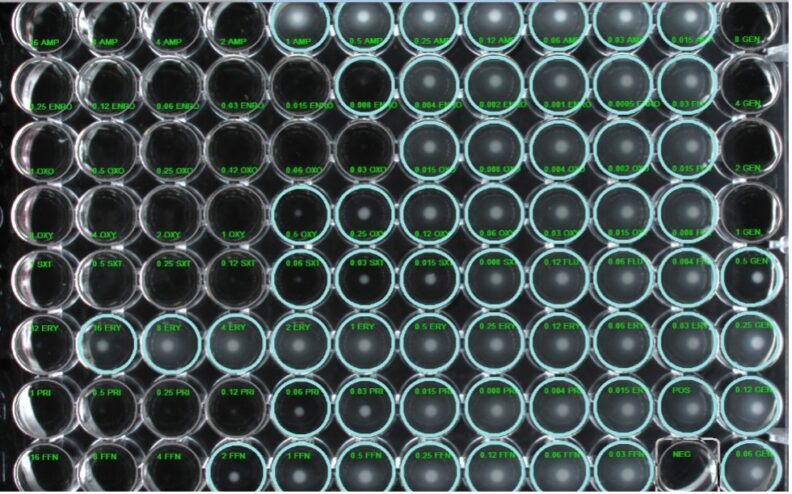
Antimicrobial susceptibility testing (AST) helps inform us of emerging resistance patterns in bacteria and allows us to select appropriate antibiotics for the treatment of bacterial diseases in aquatic species. AST is performed using two main methods: disc diffusion or broth microdilution. Disc diffusion, the more familiar of the methodologies, involves a bacterial inoculum being streaked onto an agar plate with different antimicrobial disks placed in contact with the surface of the plate. After incubation, the zone diameter (ZD), or area of no visible bacterial growth around an antimicrobial disk, is measured. In the second method, broth microdilution, a bacterial inoculum and antimicrobial drug are dispensed into a liquid broth in a 96 well-plate. Increasing 2-fold concentrations of an antimicrobial drug are tested against the bacterial inoculum in multiple consecutive wells. After incubation, the minimum inhibitory concentration (MIC), or the lowest antimicrobial drug concentration that prevents bacterial growth, is determined. Both broth microdilution and disc diffusion, when performed using standardized methods, are validated; however, results between methods are not directly comparable (e.g. cannot compare a single MIC value to a single zone diameter value). In general, both methods correlate to each other, where MIC values falling in the susceptible category correspond to zone diameter values falling in the susceptible category, for a bacteria and drug combination. Broth microdilution (determining MIC) is a common method for many diagnostic laboratories owing to its high efficiency and capacity, however it is a more costly test type. It also benefits from increased numbers of epidemiologic cutoff values (discussed later) for aquatic-origin bacteria in comparison to disc diffusion. However, many laboratories testing bacteria from aquatic animals rely on disk diffusion due to the limited number of drugs used in aquatic animal medicine and its affordability.
The Clinical and Laboratory Standards Institute (CLSI) has set standardized methods for performing AST for aquatic animals (Vet03 document), ensuring reproducibility of AST results. The CLSI standardized methods include explicit broth and media requirements, inoculum preparation methods, and incubation environments in addition to quality control recommendations using well-characterized bacteria strains (e.g. ATCC). Quality control is an essential part of AST for both broth microdilution and disk diffusion methodologies and has been validated to the unique temperatures, incubation times and media required to grow bacteria of aquatic origin.
In order to understand laboratory test data, the most common interpretive criteria used for aquatic origin MIC or ZD data is the epidemiological cutoff value (ECV or ECOFF) which is the MIC or ZD that separates bacteria into populations with and without mutational resistance. Non-wild-type bacterial populations are expected to have mutational resistance to an antibiotic, whereas wild-type bacterial populations are not expected to have mutational resistance. The ECV defines for us the highest MIC (broth microdilution) or smallest zone diameter (disc diffusion) where bacterial isolates are wild-type. For aquatic species, we have MIC and zone diameter ECVs for 4+ antibiotic classes against Aeromonas salmonicida and Aeromonas hydrophila, and MIC epidemiological cutoff values for 6+ antibiotic classes against Flavobacterium columnare and Flavobacterium psychrophilum. It is important to note,ECVs differ from clinical breakpoints (discussed next) because ECVs do not have proven clinical relevance.
A clinical breakpoint is the MIC or ZD that categorizes a bacteria as susceptible, intermediate, or resistant. The development of breakpoints requires extensive data on pharmacokinetics and clinical efficacy of antibiotics to treat bacteria (e.g. clinical trials). Currently, we only have breakpoints for oxytetracycline and oxolinic acid against Aeromonas salmonicida—these breakpoints having been established in Atlantic salmon. As performance of pharmacokinetic and clinical trial studies in aquatic animals is challenging, the development of clinical breakpoints has lagged significantly in comparison to ECV development.
Antimicrobial susceptibility testing is a complex endeavor requiring adherence to CLSI standardized test methods and use of quality control, which ensures the accuracy and comparability of MICs and ZD over time and between laboratories. It is particularly imperative that AST data included in publications follow standardized test methods to reduce potentially harmful conclusions about antimicrobial resistance in aquatic species. Additionally, high quality data supports work towards determining more ECVs (non-wild-type and wild-type) and eventually developing breakpoints (susceptible, intermediate, resistant) for new antibiotic-bacteria-aquatic host combinations.
At the Washington Animal Disease Diagnostic Laboratory, we adhere to CLSI standardized test methods and quality control, and utilize aquatic animal-specific broth microdilution plates. Additionally, we are available to consult with clients to ensure the testing and data is appropriate and useful to support optimal fish health and antimicrobial stewardship principles.
Additional background information regarding AST (in all animal species). Feel free to contact us with any questions regarding AST for aquatic species.